Researchers at St. Jude Children’s Research Hospital have uncovered how structural changes in the SPOP protein help explain cancer-associated mutations whose effects were previously unclear.
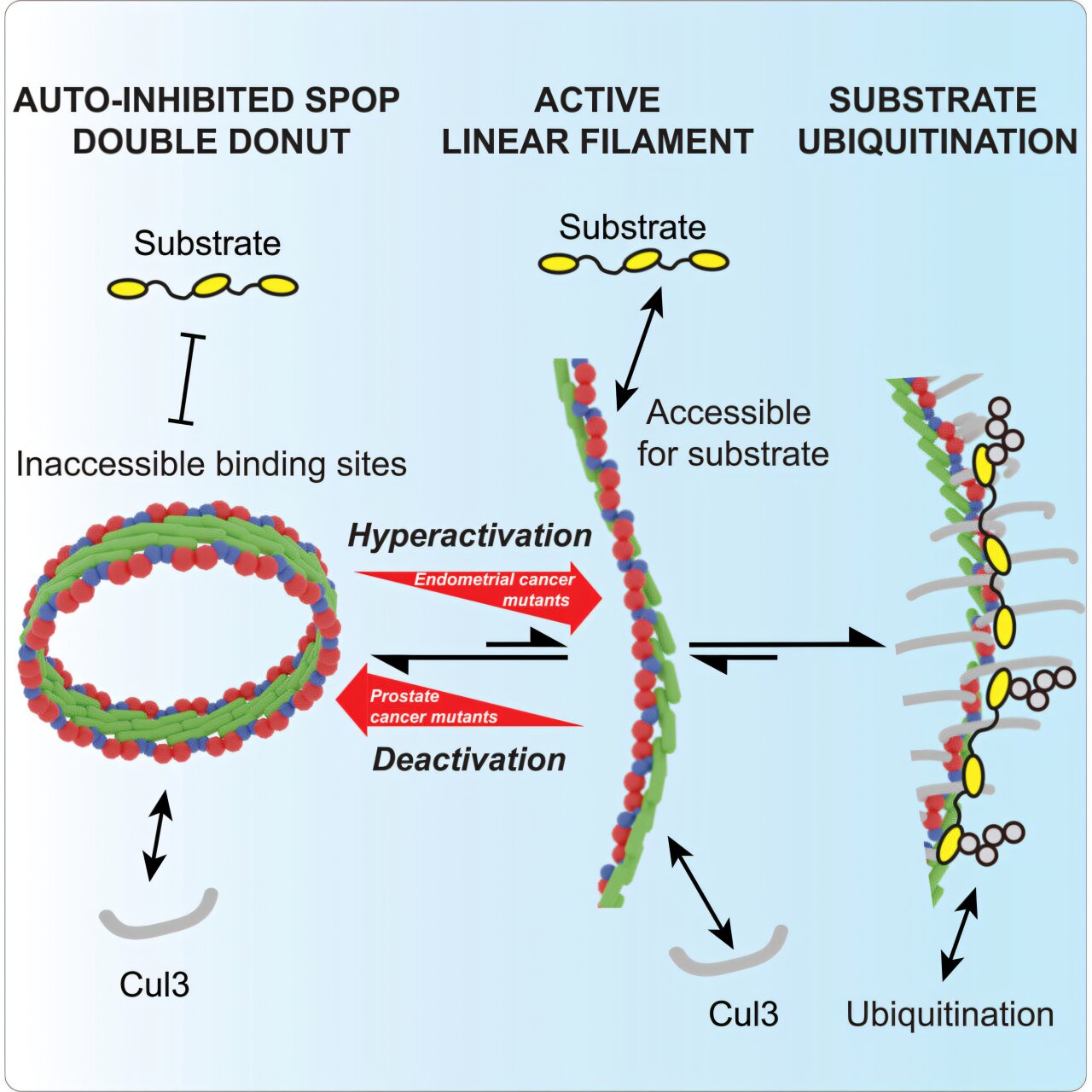
SPOP forms part of an E3 ubiquitin ligase complex that controls the levels of selected cellular proteins, including the gene regulators BRD2, BRD3 and BRD4. When these proteins are not properly regulated, they can contribute to cancer development. Although some SPOP mutations interfere directly with substrate binding, mutations found elsewhere in the protein have been more difficult to understand. Using structural studies, the researchers found that SPOP can switch between two distinct assemblies. In its inactive state, between 22 and 30 SPOP molecules form two stacked rings described as a “double donut”. When activated by its binding partner Cullin-3, SPOP instead favours a linear filament.
The study showed that cancer mutations can disrupt the normal balance between these states. Gain-of-function mutations, which increase SPOP activity, favour the active filament form. Loss-of-function mutations, which reduce its activity, favour the inactive double-donut structure. These mutations may therefore prevent SPOP from responding normally to cellular signals. The researchers also linked SPOP structure to its location within nuclear speckles, which are membraneless compartments inside the nucleus. The inactive form was strongly associated with these speckles, while activating mutations moved SPOP into the surrounding environment.
The findings provide a structural framework for understanding previously unexplained SPOP mutations and may support future efforts to control SPOP activity therapeutically. However, several common cancer mutations remain unexplained, indicating that further research is needed.
_________________________________________________________________________________________________________
The article can be accessed on: Medicalxpress
Image Credit: Molecular Cell (2026). DOI:10.1016/j.molcel.2026.06.030