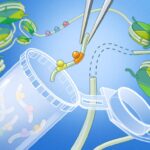
The study revealed that Pol II functions like a “finely tuned automobile” with multiple speed modes, or “gears,” each controlled by specific regulatory proteins. They determined that P-TEFb acts as a master switch, unlocking the enzyme’s full activity. PAF1C is Pol II’s main accelerator, snapping transcription into rapid motion upon binding, and RTF1, which requires PAF1C, provides an additional speed boost, shifting the enzyme to high gear. This control pacing is crucial for proper gene expression.
The platform itself is a major achievement, proving that single-molecule visualisation is possible in a fully reconstituted mammalian system. This tool provides new insight into factors like P-TEFb, which is considered a promising drug target for leukemia and solid tumours, and can now be applied to other complex, long-standing questions in biology.
Image credit: Pixabay/CC0 Public Domain (Phys.org)
Article can be accessed on: Phys.org