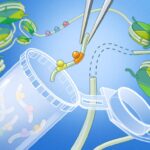
A translation-control strategy based on DNA–mRNA hybrids. The damaged base (in red) is removed by a repair enzyme, after which the DNA and mRNA dissociate, allowing translation factors and ribosomes to bind and initiate protein translation.
mRNA, known from COVID-19 vaccines, is a technology that delivers the blueprint for proteins in the body, but sudden, excessive protein production can cause serious side effects such as pulmonary embolism, stroke, thrombosis, and autoimmune diseases. To address this, Professor Yong Woong Jun’s team developed a strategy to control the timing and rate of protein production from mRNA, allowing safer, personalised treatments. Their method attaches slightly damaged DNA fragments to mRNA, which act as a “shield” to delay the attachment of the cell’s protein machinery, preventing a sudden surge in proteins. Over time, natural enzymes degrade the DNA fragments, gradually restoring normal protein production. The length and degree of DNA damage can be adjusted to precisely control when and how proteins are produced, and even multiple mRNAs can be administered to produce proteins sequentially, potentially replacing complex multi-injection treatments.
Published in Angewandte Chemie International Edition, this simple, safe, and cost-effective approach could reduce side effects and enable mRNA therapeutics for applications requiring precise protein regulation, such as stroke, cancer, and immune diseases. Professor Jun emphasises that this chemical approach provides a foundation for precision mRNA treatments tailored to diverse diseases.
Image Credit: Angewandte Chemie International Edition (2025). DOI: 10.1002/anie.202516389 (Phys.org)
By The Korea Advanced Institute of Science and Technology (KAIST)
Article can be accessed on: Phys.org