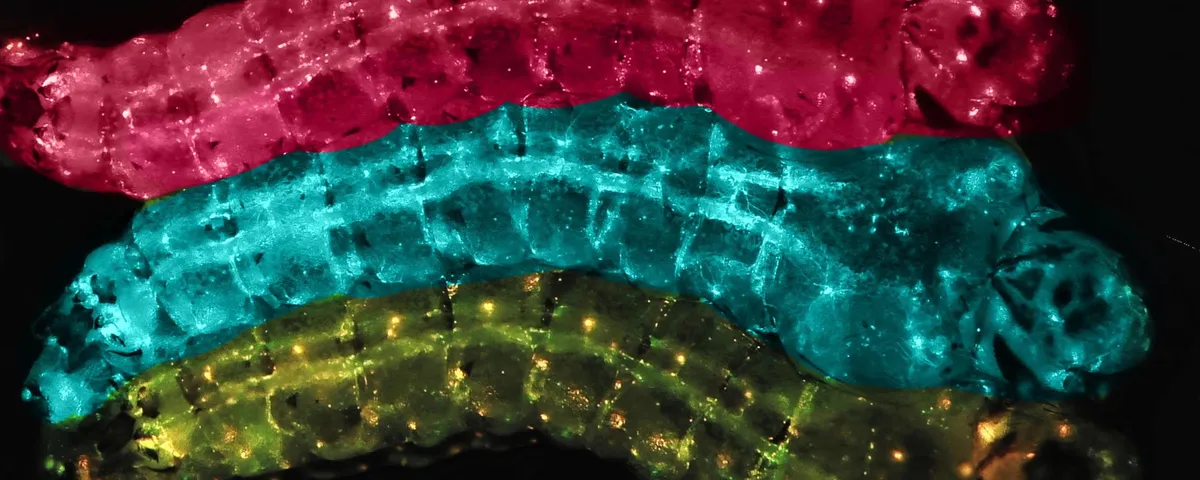
A new type of gene drive can render mosquitoes resistant to malaria infection. Mosquito larvae carry naturally occurring variants of the FREP1 gene that are either susceptible (pink or yellow) or refractory to parasite infection (blue).
From insecticides to vaccines, scientists have developed a range of approaches to combat the spread of malaria. As mosquitoes adapt resistance to insecticides and the Plasmodium parasites they transmit become resistant to drugs, cases of malaria continue to creep higher, claiming hundreds of thousands of lives each year.
A team of researchers from the University of California, San Diego (UCSD) and Johns Hopkins University has collaboratively devised a new strategy to stop the disease in its tracks. Using CRISPR-Cas9 gene editing technology, the researchers inserted a naturally occurring variant into a gene in mosquitos to render them immune to malaria infection. The results, published today in Nature, describe a ‘phantom’ allelic drive in mosquitos that can disappear after it stops them from spreading the disease to humans.
In previous studies, researchers have investigated the use of CRISPR-Cas9 gene editing technology to create gene drives in mosquitos. In the present study, developmental biologist Ethan Bier of UCSD and his colleagues took a slightly different approach to the concept of gene drives. “We [wanted] to change the structure of the existing [mosquito] population such that it carries a variant that’s naturally occurring, that is, one that renders the mosquitoes refractory to malaria transmission,” Bier explained.
The team used CRISPR-Cas9 to create a system similar to a gene drive that would bias the inheritance of the FREP1Q224 allele in larger populations of mosquitos, conferring widespread resistance to Plasmodium parasites. The team had previously used this approach to ‘re-wild’ fruit flies, reversing their resistance to pesticides.
Image credit: Li, Bier lab, UCSD