August Weismann’s germ plasm theory of the late 19th century proposed that only germ cells such as sperm and egg cells in animals or pollen and ovule cells in plants transmit genetic information to the next generation, while somatic mutations represent an evolutionary dead end. This theory is well-validated in animals, where germline segregation occurs early in development. However, because plants develop reproductive organs late, it was widely believed that plant germline segregation occurs late (during flower formation), suggesting somatic mutations might be heritable.
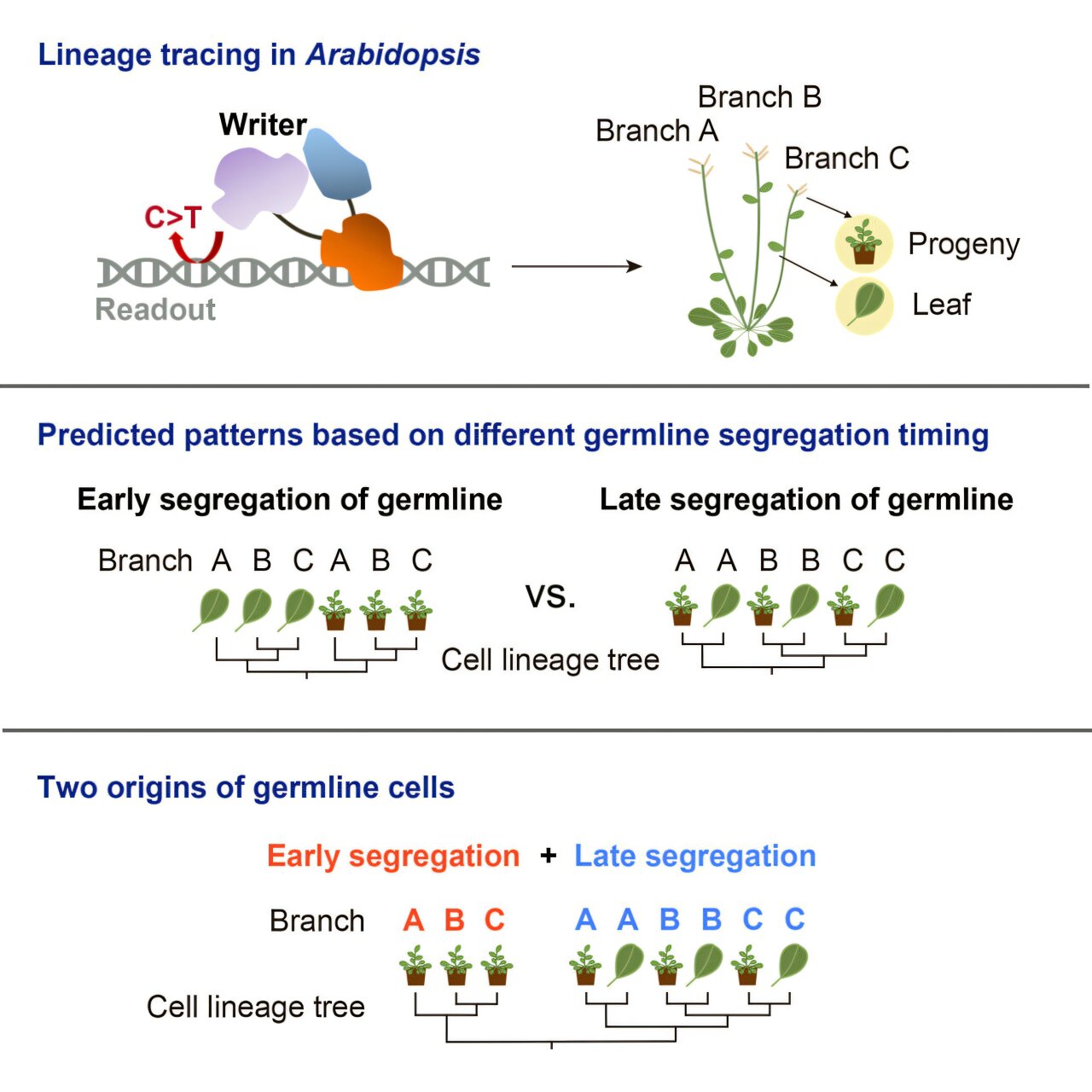
To test this, researchers from Dr. Qian Wenfeng’s lab at the Institute of Genetics and Developmental Biology (IGDB) of the Chinese Academy of Sciences studied Arabidopsis. Using a dynamic editing-based lineage tracing system, the researchers tracked cell trajectories. During division, the base editor AID (acting as a “writer”) continuously introduced heritable mutations into a synthetic DNA “readout” sequence, allowing lineage information to accumulate.
Through deep sequencing, the team identified somatic mutations in parental leaves and germline mutations transmitted to the progeny. These were used to reconstruct a cell lineage tree connecting somatic and germline cells. The results revealed two distinct patterns: some germline cells segregated during inflorescence meristem formation (late segregation), while others segregated earlier than branch formation (early segregation).
This early segregation provides a plant counterpart to Weismann’s theory, showing that germline segregation in Arabidopsis occurs earlier than previously believed. Ultimately, the study illustrates how plants balance developmental plasticity with safeguarding the genetic integrity of their offspring.
_________________________________________________________________________________________________________
The article can be accessed on: Phys.org
Image credit: Current Biology (2026)